

Slow Loris
Project Introduction
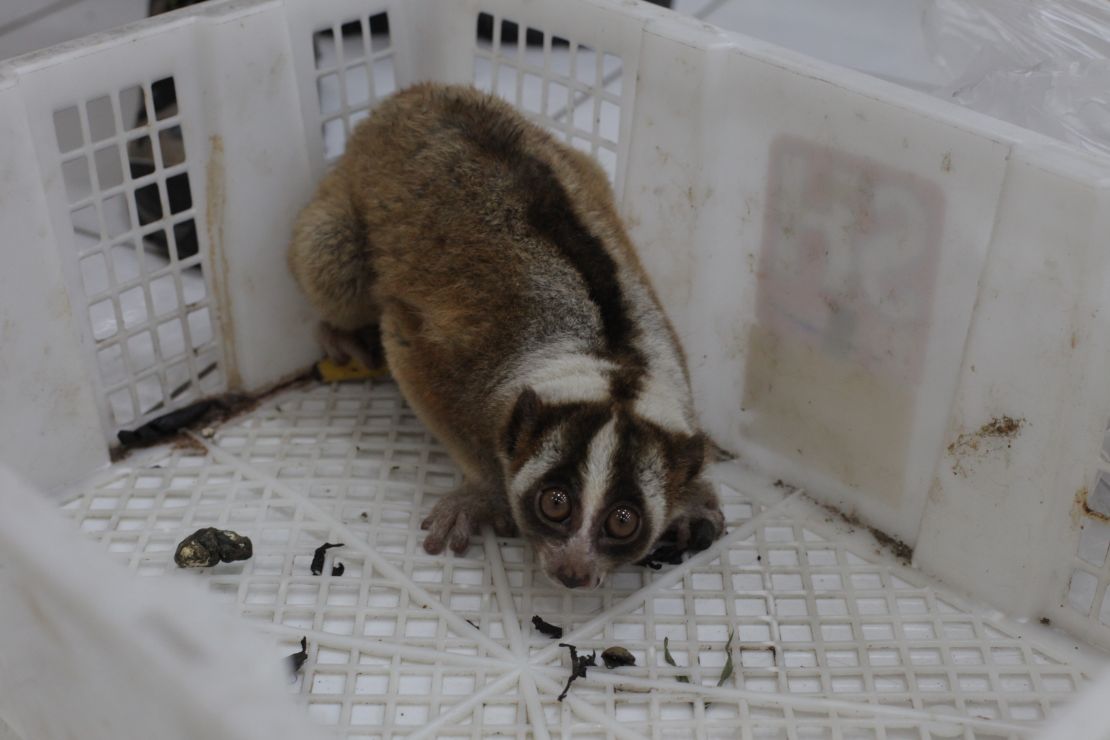
The slow loris in Indonesia is in serious danger of extinction and the greatest threats to its survival are habitat loss and the illegal trade in wildlife. Its huge brown eyes and soft fur make this small nocturnal primate highly prized as a pet and the victim of an online craze created by videos on the internet. Slow lorises are poached from the wild and illegally sold on the street, in animal markets and increasingly on social media sites. The slow lorises’ teeth are clipped off by the traders to make them easier to handle, resulting in the death of many of them from blood loss or infection before they are sold.
Once their teeth have been clipped, rescued lorises are no longer able to fend for themselves back in the wild. In some cases, thanks to assistance and advice from our team of volunteer veterinary dental specialists, it is possible to repair the damage but we also provide a permanent home at our centre for lorises that can never be released.
Our Work with Slow Lorises
Our slow loris conservation project, run in partnership with YIARI, is dedicated to protecting these small, nocturnal primates from the illegal wildlife trade. Slow lorises are often captured from the wild and sold as pets or exploited for tourist selfies. Traders usually clip or remove their teeth - a brutal practice that prevents them from defending themselves and makes them unsuitable for release.
YIARI rescue slow lorises from markets, smugglers, and private homes, providing expert veterinary care and rehabilitation in specially designed facilities. If they are assessed as fit for survival, they are released into protected forest habitats in Java and West Kalimantan. The team also monitors released animals, conducts field research, and works closely with local communities to raise awareness and reduce demand for lorises as pets. Their work addresses both the immediate welfare of individual animals and the long-term survival of the species in the wild.
e23f.jpg)
Top Slow Loris Facts
- Slow lorises are divided into nine separate species: the Bengal, Bornean, Sunda or greater, Hiller’s, Javan, Kayan, Philippine, pygmy and Sody’s. The two species we rescue are:
- Javan slow loris – Nycticebus javanicus
- Sunda or greater slow loris – Nycticebus coucang
- Javan slow lorises are listed as Critically Endangered on the IUCN Red List of Threatened Species, Sunda slow lorises are listed as Endangered. Both face a high risk of extinction in the wild.
- The slow loris is a nocturnal primate that has forward-facing eyes and human-like hands with an opposable thumb.
- The name ‘loris’ is Dutch and means ‘clown’, which probably comes from the facial features that help to define the species.
- Although slow lorises are seen as slow movers, they frequently ’race walk’ and can move up to 8 km per night. They are also able to remain totally still for hours on end if required.
- Their movement looks similar to that of a snake due to their twisting movement caused by having several more vertebrae in their spine than other primates.
- The slow loris has one of the longest tongues of all the primates, which they use to drink nectar.
- The slow loris species is easily captured because of its slow movement, nocturnal habits, and its tendency to sleep on exposed branches.
- The loris is the only existing venomous primate species in the world. Its venom is produced by mixing secretions from a gland on its elbow with its own saliva, which is then penetrated into the bloodstream of its victims using its razor-sharp teeth.
- The slow loris is an omnivore with a diet consisting of flowers, sap, nectar, fruit, insects, eggs, birds, and small vertebrates like lizards.
- Slow lorises are seed dispersers and pollinators which helps to regenerate their forest habitats.


